The New Hunter Gatherer has been in a sort of Winter's hibernation. I apologize for the absence, but somehow the rhythms of my life took over and forced a narrowing of focus. Winter has been about family and it's many demands: holiday celebrations (we do Hanukkah and Christmas), illnesses--including two trips to the hospital, and my sister's gala wedding that my children and I got to take part in many ways.
We are just now emerging into our South Florida Spring, which is making it's appearance with a vengeance. We have 80 degree weather almost daily and the mango trees are in full bloomy dress, calling all insects and troubling all allergy sufferers. Even the avocados are blooming--it seems very early. So I suppose I am talking about the seasonality of things today--that our activities and our food can and should be informed by the flow of the natural world around us.
Here, that can be a bit more difficult or subtle, depending on our orientation and sensitivities. The calendar and my ancestry may say that I should be eating heavy stews, as mid-February is serious winter in most places, but when I walk outside the ground is steaming and the air is full of avian courting. This presents a dilemma. My mind wants braises. My body wants to go lighter. This is where my old Macrobiotic training kind of kicks in unbidden: look to the local environment. And interpret it with a heavy dose of modern sensibilities (Macrobiotic teaching was actually a latter day invention based on older traditions--therefore a blueprint of sorts for our own process). I look at traditional foods in similar climates for inspiration during this odd season.
When it rains, I make soup. Never mind that the rain is as warm as my shower. Rain calls for soup, a cup of tea, a book. When I can get away with it while respecting family tastes, I make those soups and stews with an Asian spin. I pull out the coconut milk and Thai curry paste. I use as much seafood as I can get away with (picky kids again). Or I make Indian curries and Mexican posoles. These foods are stews adapted to the heat, perfect for our sunny Winter and steamy Spring. If I am really pressed for time, or if I have a bunch of odds and ends in the fridge that want using, I improvise. I experiment, and some of these experiments have turned into old standby recipes over time.
My friend J. loves my Thai-inspired seafood stew. It took a while to convince her that it is ridiculously easy to make, as long as you have a few things on hand. Actually, it even fits my idea of a "shelf-supper"--one I can make when I don't have much of anything fresh on hand--because it uses the few canned and frozen staples I keep around.
This is what I do (and get ready, because it goes fast): I set some chicken or fish stock to thawing in warm water. I saute an onion, some garlic, some ginger if I have it. I might add other veggies if I have or want them--or want to use them up. Red peppers are pretty, carrots and celery add bulk, greens or frozen peas I add at the end. There are many possibilities. Next I add the stock and a can of coconut milk. I use full-fat coconut milk with no preservatives, and I try to use a brand that has no thickeners as well (hard to find--there is one brand availably locally). If I have no coconut milk, which is rare, I use thinned coconut cream, sometimes marketed as coconut butter. This is NOT the product sold for pina coladas--instead it is made like most nut butters, grinding the meat of the slightly dried coconut with no added ingredients (the other stuff is loaded with sugar).
Ok, so now you have a broth with veggies. Almost done. Set the table, or get someone else to do it--you have to pay attention and throw a salad together too . . . Now you add some frozen seafood. I sometimes use a mix that has no additives--it has shrimp, scallops, octopus, and squid, or I use wild shrimp, which I don't bother to peel, but you might. I actually eat the shells and find the shrimp stays more moist this way--less risk of turning them to leather. All that's left is seasoning while the seafood cooks, which happens very quickly, in mere minutes. Seasonings: some Thai curry paste (red or green, your choice), fish sauce, lemon or lime juice and maybe a smidge of honey. If you have basil or mint (dried or fresh) that lends an authentic air, but I rarely bother. Same with chopped cilantro, scallions or crisply friend shallots--nice additions, but this is supposed to be a painless shelf supper.
That's it. Taste it. Does the balance of salty, spicy, sour and sweet work for you? If not, play with it. Go open a bottle of wine or a an unpasteurized beer, if that's your thing. Or pour a glass of kombucha. Then, sit down to a simple supper with not-so-simple flavors.
I hear you asking about amounts. Sigh. I can't really say exactly, but I will try--for you. For my family, which is usually 5 or 6 at dinner these days, I might use two jars of stock (4-6 cups?), an onion, a cup or more of other veg, a bag of whatever seafood (around a pound) and season to taste. The latter means start with a little an add till you like it. There is no rule about that--it's what you like. If you can't stand fish sauce, use a bit of tamari (but do try the fish sauce at least once, as it is very mild and gives a subtle flavor that soy sauces can't). If you are not fond of spice, go easy on it. And so on.
So today it looks like we're in for rain again. And I am going to visit J. And maybe we'll make soup. Because that's living with the seasons in our neighborhood. And to you I have this suggestion: go enjoy the season, whichever one it happens to be in your neck of the woods! And send me the recipes that come from your kitchen improvisations . . .
Tuesday, February 19, 2008


Monday, December 10, 2007
LoCoMotion!
We just received our first regular delivery of farm foods yesterday. After months of organizing and much work from Steve, and with some help from others, it was absolutely heartening to see everyone's enthusiasm and support flowing as freely as the pet milk! (By the way, my kitty just adores this milk. Spoiled Rotten, I'd say!) Thanks to all of the early comers who helped unload the truck. Thanks to Sarah for your help in getting the Joash milk. And thanks to all of the farmers who are supplying us with such incredible REAL food! The milk fairly flew out of the coolers, including the extra that Steve was able to bring.
We are all so fortunate, considering how far one has to go in this big state to get this "local" food, that Steve is willing to bring it here for us. He drove to several different farms on Saturday, ending up in the Panhandle at 2am to get the Joash milk. Then he made it here around 1pm on Sunday, after picking up his mom, Josephine (I love seeing her every trip. She makes the kombucha--come try some!). This is a labor of love, and Miami thanks you!
I sealed my fate as a bad (or maybe just very tacky) Jewish Mama by serving my family pastured pork blade steaks from Full Circle Farm for dinner. Thanks to Dennis and his yummy meat, I only had to add a bit of garlic and rosemary (from my friend DeAnna in the Redlands) before they hit the grill. I added a salad from Bee Heaven greens. Are we lucky or what?
At our house we celebrated the conjunction of Hannukah and the arrival of the milk with a chocolate tasting. I had found the incredible Vosges chocolates which we paired with rich milk, also from Dennis (Meow!) Some of the flavors: sea salt/almond, pasilla chili/cinnamon, cardamom/walnut/dried plum, chicory coffee/cocoa nibs, bacon/sea salt . . . Yes, BACON. And wow was that interesting! Not kosher--so sue me--but very cool!
So we are on our way. We are now able to access real food, sourced locally. Most of the food we get is either produced in Florida or sold by small local businesses, like Delicious Organics, that put a lot of care and thought into what they bring from other places (someone has called this shopping "LoCo"). Come join this movement. We sure are eating well!
We are all so fortunate, considering how far one has to go in this big state to get this "local" food, that Steve is willing to bring it here for us. He drove to several different farms on Saturday, ending up in the Panhandle at 2am to get the Joash milk. Then he made it here around 1pm on Sunday, after picking up his mom, Josephine (I love seeing her every trip. She makes the kombucha--come try some!). This is a labor of love, and Miami thanks you!
I sealed my fate as a bad (or maybe just very tacky) Jewish Mama by serving my family pastured pork blade steaks from Full Circle Farm for dinner. Thanks to Dennis and his yummy meat, I only had to add a bit of garlic and rosemary (from my friend DeAnna in the Redlands) before they hit the grill. I added a salad from Bee Heaven greens. Are we lucky or what?
At our house we celebrated the conjunction of Hannukah and the arrival of the milk with a chocolate tasting. I had found the incredible Vosges chocolates which we paired with rich milk, also from Dennis (Meow!) Some of the flavors: sea salt/almond, pasilla chili/cinnamon, cardamom/walnut/dried plum, chicory coffee/cocoa nibs, bacon/sea salt . . . Yes, BACON. And wow was that interesting! Not kosher--so sue me--but very cool!
So we are on our way. We are now able to access real food, sourced locally. Most of the food we get is either produced in Florida or sold by small local businesses, like Delicious Organics, that put a lot of care and thought into what they bring from other places (someone has called this shopping "LoCo"). Come join this movement. We sure are eating well!
Tuesday, December 4, 2007
What I Learned over Thanksgiving Vacation . . .
O.K. Maybe I didn't exactly learn these things from scratch, but I put into use some lessons over these last crazy weeks that I though might be useful to us all. I/we have been away from home under varying circumstances and have been able to eat well and stay healthy throughout. How? Maybe some of my recent experiences will help:
About three weeks ago I went to the Weston A. Price Foundation International conference--which was as incredibly full of information, new tastes, new people, new ideas as I remembered from last year. There was, of course, really wonderful food, provided by small farmers and prepared according to traditional principles. But there were also close to two days of travel--on airplanes and through airports known for lack of anything decent to eat, even for folks less picky about what they put into their bodies than I am. I should add that there is one very good restaurant at Dulles, the airport in Washington that I was using, that has local food and cooks it with more care than anyone has a right to expect in that setting. I did not need to eat there, though, because I take a bit of time to plan my food for such trips.
What I carry on planes: crispy nuts, dried fruit (I think I had persimmons and figs), cubed cheese, sliced salami, an apple (one for each person, if in a group), "baby" carrots, hard boiled eggs, homemade crackers. These are usually things I have on hand at all times at home. If I have them, I might add tangerines or other easy to manage fruit, and any travel-friendly leftovers, such as sliced meat or chicken wings. I don't shy away from a few small containers, because I have found them to be useful for the return trip, to transport things I can gather during my stay. I also pack a few extra zipper storage bags for the return trip, a napkin and an empty water bottle. I have found that I prefer to fill my bottle from a fountain, after going through security, to drinking from commercial plastic bottles. I can't speak to the science of whether plastic particles are worse than chlorine for us, but the plastic tastes much worse to me.
The same week I was in DC, my husband and kids went to a regatta in Naples. They had a kitchen in the hotel, which is a basic necessity for us, though some folks I know travel with a hotplate or other small indoor heat source--some even use hotpots to reheat food cooked at home. I had planned every meal and organized it so that my 13 year old could easily take charge of both packing and cooking the food. I find that's important whether I will be there or not. When we go camping I do the same thing, because I really don't want a lot of leftovers and some meals are easier to make then others when you are without the luxury of a well-equipped kitchen. As a matter of fact, if I am not sure of the motel's equipment, I pack some basics from my camping gear--who wants to get stuck without a corkscrew when you are staring at a nice bottle of wine?
Car trips are a bit different than plane travel, because I can take coolers. I have been known to pack a roast chicken and salad fixings to feed us at a lovely wooded rest area (there are a few of those!) I have taken pate (the recipe I previously posted) and gravlax (I use the recipe from Nourishing Traditions, replacing the Rapadura with honey) that I had on hand, both of which make great lunch and snack foods. I pack more fruit, and I can include things that might have gotten squished in a carry-on under the seat in front of me, like plums, grapes, pears. I plan on more fruit when we travel because the disruption in routines can cause constipation. When I pack a cooler, I use water bottles filled with frozen filtered water for most of the "ice packs," rounding out with gel packs. In a pinch--when we didn't have a freezer to refreeze the gel packs and water bottles, I have filled the water bottles with ice at a motel ice machine, adding water to make packs that will last pretty long and not make a mess of the food. If we are headed to a place where I will be cooking (like a regatta or camping) I will pack the meat frozen, and may even precook some things and freeze them--everything travels better that way, and I don't have to fret about any delays.
The other recent "travel" experience was actually two trips to the emergency room with two different kids. One turned into an overnight stay, so I really did need good food. I think hospital food rivals airplane food for being gross and devoid of nutrition. I am not sure how people are supposed to heal eating such processed, sugary junk, but I didn't have to find out! As soon as I decided to take my son to the ER the day before Thanksgiving (he had signs of appendicitis), I quickly packed a bag with a change of clothes, a book, a sketchbook, my phone charger, and some food. Since I was not sure how long I would be without refrigeration, I used a small insulated lunch box with a gel pack and included hard cheese, crackers, nuts, dried fruit and a jar of frozen chicken stock. I added a china cup (for microwaving, so I don't have to use styrofoam--microwaving is bad enough!) and some tea bags, herb for Ian and black for me. Once he was admitted, he was allowed to order what food he wanted from the hospital's food service. This is an improvement over other systems, and allowed us to chose the most "real" food available: bacon and eggs, a hard boiled egg for me, fresh fruit, grits. Yes, some of these are compromises--I would not normally use commercial bacon or degermed grits, and the grits would be soaked. But, under the circumstances, these were pretty good choices.
Pretty good choices. That's what Rick and I have worked to refine for travel. He travels a lot for business and used to come home with digestive upsets, some of which can last longer than the original trip! He takes nuts and dried fruit, sometimes a piece of fresh fruit, sometimes a can of sardines. Eating out, he has learned to order fish or meat grilled or cooked in butter (if real, he always asks) or olive oil. He gets salad and vegetables without dressings and sauces, unless he can be really sure what is in them. Instead, he asks for olive oil, melted butter, lemon or lime, to season them. Bacon and eggs (boiled, poached or fried, to avoid liquid egg products) and fruit are pretty reliable for breakfast. Using these tactics, he has been able to stay healthy and have some pretty good meals.
Travel is fun for us all, and we love tasting new foods. Still, because of our commitment to eating real foods, and owing to a few sensitivities in some family members, it serves us better to take much of our food and to experience local ingredients from farmers and markets, rather than eat our meals out. This ends up being more economical, healthier, and often has given us connections in a community that we would have otherwise missed. I know it might sound like I do a lot of work, but really the work is in the planning--on the trip itself it is usually stress-free and enjoyable, perhaps even more so than it would be eating icky food in crowded restaurants with a bunch of finicky kids.
About three weeks ago I went to the Weston A. Price Foundation International conference--which was as incredibly full of information, new tastes, new people, new ideas as I remembered from last year. There was, of course, really wonderful food, provided by small farmers and prepared according to traditional principles. But there were also close to two days of travel--on airplanes and through airports known for lack of anything decent to eat, even for folks less picky about what they put into their bodies than I am. I should add that there is one very good restaurant at Dulles, the airport in Washington that I was using, that has local food and cooks it with more care than anyone has a right to expect in that setting. I did not need to eat there, though, because I take a bit of time to plan my food for such trips.
What I carry on planes: crispy nuts, dried fruit (I think I had persimmons and figs), cubed cheese, sliced salami, an apple (one for each person, if in a group), "baby" carrots, hard boiled eggs, homemade crackers. These are usually things I have on hand at all times at home. If I have them, I might add tangerines or other easy to manage fruit, and any travel-friendly leftovers, such as sliced meat or chicken wings. I don't shy away from a few small containers, because I have found them to be useful for the return trip, to transport things I can gather during my stay. I also pack a few extra zipper storage bags for the return trip, a napkin and an empty water bottle. I have found that I prefer to fill my bottle from a fountain, after going through security, to drinking from commercial plastic bottles. I can't speak to the science of whether plastic particles are worse than chlorine for us, but the plastic tastes much worse to me.
The same week I was in DC, my husband and kids went to a regatta in Naples. They had a kitchen in the hotel, which is a basic necessity for us, though some folks I know travel with a hotplate or other small indoor heat source--some even use hotpots to reheat food cooked at home. I had planned every meal and organized it so that my 13 year old could easily take charge of both packing and cooking the food. I find that's important whether I will be there or not. When we go camping I do the same thing, because I really don't want a lot of leftovers and some meals are easier to make then others when you are without the luxury of a well-equipped kitchen. As a matter of fact, if I am not sure of the motel's equipment, I pack some basics from my camping gear--who wants to get stuck without a corkscrew when you are staring at a nice bottle of wine?
Car trips are a bit different than plane travel, because I can take coolers. I have been known to pack a roast chicken and salad fixings to feed us at a lovely wooded rest area (there are a few of those!) I have taken pate (the recipe I previously posted) and gravlax (I use the recipe from Nourishing Traditions, replacing the Rapadura with honey) that I had on hand, both of which make great lunch and snack foods. I pack more fruit, and I can include things that might have gotten squished in a carry-on under the seat in front of me, like plums, grapes, pears. I plan on more fruit when we travel because the disruption in routines can cause constipation. When I pack a cooler, I use water bottles filled with frozen filtered water for most of the "ice packs," rounding out with gel packs. In a pinch--when we didn't have a freezer to refreeze the gel packs and water bottles, I have filled the water bottles with ice at a motel ice machine, adding water to make packs that will last pretty long and not make a mess of the food. If we are headed to a place where I will be cooking (like a regatta or camping) I will pack the meat frozen, and may even precook some things and freeze them--everything travels better that way, and I don't have to fret about any delays.
The other recent "travel" experience was actually two trips to the emergency room with two different kids. One turned into an overnight stay, so I really did need good food. I think hospital food rivals airplane food for being gross and devoid of nutrition. I am not sure how people are supposed to heal eating such processed, sugary junk, but I didn't have to find out! As soon as I decided to take my son to the ER the day before Thanksgiving (he had signs of appendicitis), I quickly packed a bag with a change of clothes, a book, a sketchbook, my phone charger, and some food. Since I was not sure how long I would be without refrigeration, I used a small insulated lunch box with a gel pack and included hard cheese, crackers, nuts, dried fruit and a jar of frozen chicken stock. I added a china cup (for microwaving, so I don't have to use styrofoam--microwaving is bad enough!) and some tea bags, herb for Ian and black for me. Once he was admitted, he was allowed to order what food he wanted from the hospital's food service. This is an improvement over other systems, and allowed us to chose the most "real" food available: bacon and eggs, a hard boiled egg for me, fresh fruit, grits. Yes, some of these are compromises--I would not normally use commercial bacon or degermed grits, and the grits would be soaked. But, under the circumstances, these were pretty good choices.
Pretty good choices. That's what Rick and I have worked to refine for travel. He travels a lot for business and used to come home with digestive upsets, some of which can last longer than the original trip! He takes nuts and dried fruit, sometimes a piece of fresh fruit, sometimes a can of sardines. Eating out, he has learned to order fish or meat grilled or cooked in butter (if real, he always asks) or olive oil. He gets salad and vegetables without dressings and sauces, unless he can be really sure what is in them. Instead, he asks for olive oil, melted butter, lemon or lime, to season them. Bacon and eggs (boiled, poached or fried, to avoid liquid egg products) and fruit are pretty reliable for breakfast. Using these tactics, he has been able to stay healthy and have some pretty good meals.
Travel is fun for us all, and we love tasting new foods. Still, because of our commitment to eating real foods, and owing to a few sensitivities in some family members, it serves us better to take much of our food and to experience local ingredients from farmers and markets, rather than eat our meals out. This ends up being more economical, healthier, and often has given us connections in a community that we would have otherwise missed. I know it might sound like I do a lot of work, but really the work is in the planning--on the trip itself it is usually stress-free and enjoyable, perhaps even more so than it would be eating icky food in crowded restaurants with a bunch of finicky kids.
Wednesday, November 7, 2007
The Chicken Harvest

Last Saturday I learned how to harvest a chicken.
I not only learned how, I actually did it, and it wasn't as hard as I imagined it might be--that was all in my head. In reality, even the slaughtering part was very matter-of-fact and simple. Very real. It reminded me of being at a birth. It's not a novel comparison, to equate birth and death, but some might be shocked or offended at my throwing killing an animal into the mix. But when you stop to think about it, killing for food is elemental for humans and animals, it is a part of our DNA, our natural lives. We watch lizards catch insects with no twinges of sadness. We are fascinated with lions eating their prey, looking like our own cats with backyard birds (this is one reason why we watched National Geographic specials, is it not?).
We were a group of ten, gathered at our local CSA on a cool (Miami-style) and glittery Fall day in South Florida. The roosters--noisy boys that they are--needed culling and we lucky ones were about to learn the process of turning bird into dinner. After a few false starts while we discovered just how hard it is to catch a rooster, even in a chicken tractor, we roun
 ded them up into a holding cage. We only needed one demonstration, then we took turns performing each step: slaughter, scald, pluck, butcher, eviscerate. The birds were then washed and iced down. In the end, we had eleven dressed roosters (the extra was raffled off) and a bunch of heads, feet and giblets. I'll do a post on offal another day, but suffice it to say, I ended up with the heads and feet for my stock pot. Though the whole group was very game about the entire project, some things are just very new ideas to us all.
We sat down at a long table out of the sun and shared a light farm lunch. All the while, we traded recipes and stories, enjoying the company and the day. This is the essence of community in the New Millenium: Sharing skills and joys almost lost to the commodification of our food and our whole lives. To do this we have had to create all sorts of intentional groups, such as CSA's and support groups, schools of herbcraft and so on. I am sure that my great-grandmother learned to make gefilte fish from her mother or grandmother, starting with a live carp (for a wonderful children's story about this, see The Carp in the Bathtub,.) We now have to seek out the mentors and fellow travelers that would have been a part of our natural surroundings in our great-grandparents' time.
I do see that we are starting to value anew the richness of the food of the past. And I think that we really do yearn for the family dinners, the holiday gatherings, the kids who follow ours home, drawn by the warmth and the delicious smells coming from our kitchens. We love the ambiance; this is what Martha Stewart has been marketing with a vengeance for years. And we say we want real, that we
So why do we have suc

Going to a small farm for a chicken-harvesting workshop is not my answer to daily food choices--it was only one bird, after all. Instead, it is a way to respect the animal that would become our dinner, to restore that connection for every chicken going forward. It is a way to see the chicken on the plate as the culmination of a process that is real and tangible. It reaffirms my choice to eat humanely-raised pastured animals, always aware of how they lived.
And slaughtering my own rooster taught that its death is equally full of purpose and integrity.
Friday, November 2, 2007
The Old Salt
People have been asking me about salt. Not about my husband, The Old Salt. But they need to know about salt. Old, traditional salt. Real salt.
Salt. We can't live without it. Yet we have been taught to fear it. Without it, food tastes bland, somehow wrong. With it, food has heightened flavors, and it can be used to make many foods last longer.
People want to know which kind to use, how much to use, and so on. I really don't intend to write a dissertation on salt--the definitive book, Salt: A World History, has been written. But perhaps I can quickly give an orientation to salt and some resources.
Let's start with background: naturally occurring salt is not just sodium chloride. It contains a complex of many trace minerals, which vary depending on the source of the salt. Refined salt is pure sodium chloride, but usually has additives, including dextrose, synthetic iodine, flow agents, even fluoride. These differences, between the natural and the refined, may explain why for many years "experts" have told us that salt consumption is hazardous to our health. The reason we think that salt is unsafe is that studies have been done with refined salt, not the real, complex substance.
Anytime we consume a refined product that is missing key elements, the body has to compensate by drawing on it's stores of those elements--in this case, the missing minerals. This creates an imbalance, and the body--always attempting to reach homeostasis or equilibrium--will do it's best to cope. Eventually, symptoms of deficiency, and then illness, arise. Since salt functions to help regulate fluid in the body, one of the effects of using refined salt can be swelling or edema (showing an imbalance of the fluids between circulation and tissues), and the well-known effect of high blood pressure. For some interesting information on the health issues of salt, see this site.
So we need salt biologically. But really I want to talk about taste, about food. That's why we are here, after all. What salt do I use? Well, I was introduced to the real thing by my daughter who went to France--Brittany, specifically--last year. She lugged home pounds of huge, damp, grey crystals she had seen workers rake out of the salt beds at the edge of the sea. She had lived with a family who kept 25 lb sacks of The Real Thing in the pantry, and large open salt jars on the counter. She told me how this salt went liberally into most every dish, so I learned how to use this strange new substance that bears no resemblance to the stuff that pours when it rains. And I was hooked. It changes the food and it subtlety changes my relationship to the food. I taste, I add a pinch. I wait for it to dissolve, to disperse. I taste again. I am more responsive, more flexible. Measuring means nothing and the taste means everything.
I have used other real salts, and continue to do so. Here, we can buy Celtic Salt, Himalayan Salt and Real Salt. I am sure there are other great brands. The commonality is that these are unrefined salts, as found in nature--either from the sea or mined from the earth. These salts all have color and texture. They are varied and fascinating. Each has a nuanced flavor, a different use. Delicious Organics has a wonderful page exploring different aspects of salt, and they carry many types--a wonderland of choice! Find your favorite everyday salt and put it in a lovely jar on your counter top, to use liberally, to taste. Find some special salts--I noticed two smoked salts I want to try for unusual dishes. You can do the same. Explore and experiment.
As always, what the Hunter-Gatherer in me is looking for is something real, something that resonates with what I hear from the voices of the Grandmothers deep down. Those of my ancestry, of yours, sought out real and delicious foods. And they went to great lengths to get salt, because somehow they knew they could not survive without it. And neither can we.
Salt. We can't live without it. Yet we have been taught to fear it. Without it, food tastes bland, somehow wrong. With it, food has heightened flavors, and it can be used to make many foods last longer.
People want to know which kind to use, how much to use, and so on. I really don't intend to write a dissertation on salt--the definitive book, Salt: A World History, has been written. But perhaps I can quickly give an orientation to salt and some resources.
Let's start with background: naturally occurring salt is not just sodium chloride. It contains a complex of many trace minerals, which vary depending on the source of the salt. Refined salt is pure sodium chloride, but usually has additives, including dextrose, synthetic iodine, flow agents, even fluoride. These differences, between the natural and the refined, may explain why for many years "experts" have told us that salt consumption is hazardous to our health. The reason we think that salt is unsafe is that studies have been done with refined salt, not the real, complex substance.
Anytime we consume a refined product that is missing key elements, the body has to compensate by drawing on it's stores of those elements--in this case, the missing minerals. This creates an imbalance, and the body--always attempting to reach homeostasis or equilibrium--will do it's best to cope. Eventually, symptoms of deficiency, and then illness, arise. Since salt functions to help regulate fluid in the body, one of the effects of using refined salt can be swelling or edema (showing an imbalance of the fluids between circulation and tissues), and the well-known effect of high blood pressure. For some interesting information on the health issues of salt, see this site.
So we need salt biologically. But really I want to talk about taste, about food. That's why we are here, after all. What salt do I use? Well, I was introduced to the real thing by my daughter who went to France--Brittany, specifically--last year. She lugged home pounds of huge, damp, grey crystals she had seen workers rake out of the salt beds at the edge of the sea. She had lived with a family who kept 25 lb sacks of The Real Thing in the pantry, and large open salt jars on the counter. She told me how this salt went liberally into most every dish, so I learned how to use this strange new substance that bears no resemblance to the stuff that pours when it rains. And I was hooked. It changes the food and it subtlety changes my relationship to the food. I taste, I add a pinch. I wait for it to dissolve, to disperse. I taste again. I am more responsive, more flexible. Measuring means nothing and the taste means everything.
I have used other real salts, and continue to do so. Here, we can buy Celtic Salt, Himalayan Salt and Real Salt. I am sure there are other great brands. The commonality is that these are unrefined salts, as found in nature--either from the sea or mined from the earth. These salts all have color and texture. They are varied and fascinating. Each has a nuanced flavor, a different use. Delicious Organics has a wonderful page exploring different aspects of salt, and they carry many types--a wonderland of choice! Find your favorite everyday salt and put it in a lovely jar on your counter top, to use liberally, to taste. Find some special salts--I noticed two smoked salts I want to try for unusual dishes. You can do the same. Explore and experiment.
As always, what the Hunter-Gatherer in me is looking for is something real, something that resonates with what I hear from the voices of the Grandmothers deep down. Those of my ancestry, of yours, sought out real and delicious foods. And they went to great lengths to get salt, because somehow they knew they could not survive without it. And neither can we.
Sunday, October 28, 2007
Love and Liver
Today I am going to invite you into my kitchen for a cup of tea or kombucha, or whatever your pleasure . . . I just don't have any soda on hand, having not made any in a while--more on that another day. By the way, that photo at the top of the page is from my kitchen: local mangos, much used mortar and pestle handed down from my dad and all. Anyway, I wanted to talk about my recent workshop, and to give you a recipe for pate that all of the participants requested. I have been meaning to do this for a while but life intervened (my son's first regatta, which will give rise to a post about eating while we travel--but here I am distracting myself . . .)
For the workshop, I wanted a lunch that would demonstrate some of the principles of traditional diets I would be discussing during the day. I also wanted a sort of seasonal meal that would not be difficult to prepare. We ended up with an Autumn soup, crackers, chicken liver pate and a salad. We also had a variety of saurkrauts and kimchi that I had brought to show the final result of some ferments, as our hands-on project that day was sauerkraut making.
So now, do as my sweetheart does when I am cooking, pull up a chair to the doorway of my small kitchen while we talk and I start cooking.
A soaked grain cracker: Two or three days before I need crackers, I soak grain flour (in this case it was rice and cornmeal) with whey and water to cover. After 24 hours, I add eggs, coconut oil, baking soda to get a sort of cornbread batter, which I bake in a 9 x 12 pan. No, I can't tell you exactly how much of anything--that's not the recipe I promised you! (If pressed by my loyal readers, I will come up with one later . . .) When the bread is done baking, usually in 40-60 minutes, I let it cool, then slice it thinly into cracker-sized pieces which I arrange on sheet pans and place in a warm oven (about 150-200 degrees, depending on whether I can watch them). The simplest timing is to let them stay in the warm oven (lowest temp) overnight. That's it. Kind of like biscotti, they take a while, but each step that involves actual labor is short and easy. The longest step is the slicing--no big deal, really, just go slowly. I save all of the crumbs (there are always lots in gluten-free baking) in a bag in the freezer--very handy for whatever uses breadcrumbs. I also do a quicker version with coconut flour and some nutmeal instead of the soaked grain.
A basic soup (incorporating bone broth): I make all simple soups with the same general structure--saute veggies starting with onions, add softer veg, add broth, simmer. Puree, if desired. Season and accent with herbs or yoghurt, etc. This is great for leftovers and even quick stews. So the Autumn soup goes something like this: Saute onion and garlic. Add some quartered and cored apples (no need to peel). Add some winter squash chunks or even precooked (I used some pumpkin-like squash that had been baked with the bread--cut in half, seed, place face down on a sheet pan with a bit of water and bake til you can poke it with a fork easily. Then just scoop out the flesh. This is great as a side dish with lots of good grass-fed butter.) Add some broth--chicken usually, but experiment! If I have some leftover white wine, that might go in. I like to throw in some thyme if it's around. I sometimes add curry spices, like garam masala or whatever I am in the mood for. This simmers for a few minutes--until the veggies are tender, or longer if I am tied up with another project. I puree with a stick/immersion blender--a tool I find invaluable for soups. Then I add salt and pepper or whatever is missing. How do I know? I taste! Over and over. It drives one of my kids nuts that I do that, but you really can't cook well without tasting. Period. You learn over time what you like, what's missing, what would help round out the flavors. Sometimes it's a bit of lemon juice or a dribble of honey. Sometimes it's a bit of tamari or miso, or even fish sauce, each of which adds something very different from salt alone. Sometimes I can't tell, and I go looking for tasters, asking opinions (which I generally take, but I reserve the right to make the final decision). Really, recipes are just a skeleton, a framework on which to build a dish. The process might appear so loose, but it's really just flexible--if you lack an ingredient, find a substitute or leave it out. Play with your food!
My basic green salad (Live enzymes and micronutrients galore): Cut or tear the washed greens into a nice salad bowl. Add any vegetables and/or fruits. Add any cheese and/or crispy nuts or seeds. I almost always add chopped garlic. The simplest dressing I make is to drizzle everything with olive oil, add a squirt of flax oil (to add omega 3's and a nutty flavor), add the juice of a lime or lemon and a big pinch of good sea salt. Toss the whole thing well and serve. I did this whole process in five minutes at the workshop, at our worktable so everyone could watch. Sometimes I make a simplified version of Sally Fallon's Creamy Dressing (from Nourishing Traditions): in a small jar I put olive oil and wine vinegar, mustard if I think of it, salt and a bit of cream (raw and/or cultured if I have it). Shake. Herbs are nice, so's pepper if you feel like it. Add crumbled blue cheese for, you know, Blue Cheese Dressing.
The pate (about as nutrient dense and full of good fat as it gets): First off, this may be the simplest thing you ever make that ends up being so elegant. It's pretty cheap too. It can be frozen in small containers--double wrap and defrost in the fridge. Oh, and it's full of the good stuff: minerals, vitamins, fat-soluble activators. And taste--even liver haters have been known to eat this. It may rank next to bacon as the gateway meat. So try a batch! Stop throwing out those livers that come with the great pastured chickens you are buying; save them up for this pate . . . Full honors for this recipe go to a wonderful and quite traditionally focused book, Everyday Cooking with Jacques Pepin, which teaches how to cook basic French family fare--the foods Pepin's mother used to make.
Chicken Liver Pate a la Jacques Pepin (with a few notes of my own)
1 pound chicken livers (preferably pastured and/or organic)
2/3 cup sliced onions
1 clove garlic, peeled and crushed
2 bay leaves, crushed
1/4 tsp. thyme leaves
1 cup water
2 tsp good sea salt
1 1/2 cups (3/4 lb) butter, softened (preferable organic, grassfed and/or raw)
freshly ground black pepper
2 tsp Cognac or Scotch (optional, but it does add something that takes this beyond my grandma's chopped liver)
Put the livers, onions, garlic, bay leaves, thyme, water and one tsp. of salt in a saucepan; bring to a boil. Cover and cook at a bare simmer for 7-8 minutes. Remove from the heat and let sit for five minutes. Place the solids in the food processor with a metal blade (I have done this in a blender, but it's a bit trickier--you have stir it often until there is enough puree at the bottom, and maybe add some of the butter earlier to help the liquifying). As you process, you add the butter piece by piece, letting each incorporate. If the mass looks like it is breaking (like when mayonnaise breaks--it looks curdled), chill for about an hour before finishing. Add the rest of the salt (taste first, add what you need, keeping in mind that once it chills it will taste less salty), the pepper and the Cognac. Process until creamy and totally smooth. Pour into a mold or individual ramekins. This can be decorated with bits of vegetable matter (tomato skin, blanched scallions) and sealed with an aspic, but that part is maybe more trouble than it's worth for everyday. If you want to know how to do that, get the book (or email me).
In the spirit of never letting anything go to waste (that traditional or hunter-gatherer value) I often take the poaching broth and add some chopped greens and bits of whatever veg is on hand, maybe poach an egg in it and call it soup. A nice filling lunch for the cook!
At the end of the workshop one lovely woman came up to me and confided that the most important thing she had learned was that we must share food, eating together with others, and that we put love into the food--that is ultimately what makes it nourishing. And I thought I was just teaching them how to choose and cook healthy food.
For the workshop, I wanted a lunch that would demonstrate some of the principles of traditional diets I would be discussing during the day. I also wanted a sort of seasonal meal that would not be difficult to prepare. We ended up with an Autumn soup, crackers, chicken liver pate and a salad. We also had a variety of saurkrauts and kimchi that I had brought to show the final result of some ferments, as our hands-on project that day was sauerkraut making.
So now, do as my sweetheart does when I am cooking, pull up a chair to the doorway of my small kitchen while we talk and I start cooking.
A soaked grain cracker: Two or three days before I need crackers, I soak grain flour (in this case it was rice and cornmeal) with whey and water to cover. After 24 hours, I add eggs, coconut oil, baking soda to get a sort of cornbread batter, which I bake in a 9 x 12 pan. No, I can't tell you exactly how much of anything--that's not the recipe I promised you! (If pressed by my loyal readers, I will come up with one later . . .) When the bread is done baking, usually in 40-60 minutes, I let it cool, then slice it thinly into cracker-sized pieces which I arrange on sheet pans and place in a warm oven (about 150-200 degrees, depending on whether I can watch them). The simplest timing is to let them stay in the warm oven (lowest temp) overnight. That's it. Kind of like biscotti, they take a while, but each step that involves actual labor is short and easy. The longest step is the slicing--no big deal, really, just go slowly. I save all of the crumbs (there are always lots in gluten-free baking) in a bag in the freezer--very handy for whatever uses breadcrumbs. I also do a quicker version with coconut flour and some nutmeal instead of the soaked grain.
A basic soup (incorporating bone broth): I make all simple soups with the same general structure--saute veggies starting with onions, add softer veg, add broth, simmer. Puree, if desired. Season and accent with herbs or yoghurt, etc. This is great for leftovers and even quick stews. So the Autumn soup goes something like this: Saute onion and garlic. Add some quartered and cored apples (no need to peel). Add some winter squash chunks or even precooked (I used some pumpkin-like squash that had been baked with the bread--cut in half, seed, place face down on a sheet pan with a bit of water and bake til you can poke it with a fork easily. Then just scoop out the flesh. This is great as a side dish with lots of good grass-fed butter.) Add some broth--chicken usually, but experiment! If I have some leftover white wine, that might go in. I like to throw in some thyme if it's around. I sometimes add curry spices, like garam masala or whatever I am in the mood for. This simmers for a few minutes--until the veggies are tender, or longer if I am tied up with another project. I puree with a stick/immersion blender--a tool I find invaluable for soups. Then I add salt and pepper or whatever is missing. How do I know? I taste! Over and over. It drives one of my kids nuts that I do that, but you really can't cook well without tasting. Period. You learn over time what you like, what's missing, what would help round out the flavors. Sometimes it's a bit of lemon juice or a dribble of honey. Sometimes it's a bit of tamari or miso, or even fish sauce, each of which adds something very different from salt alone. Sometimes I can't tell, and I go looking for tasters, asking opinions (which I generally take, but I reserve the right to make the final decision). Really, recipes are just a skeleton, a framework on which to build a dish. The process might appear so loose, but it's really just flexible--if you lack an ingredient, find a substitute or leave it out. Play with your food!
My basic green salad (Live enzymes and micronutrients galore): Cut or tear the washed greens into a nice salad bowl. Add any vegetables and/or fruits. Add any cheese and/or crispy nuts or seeds. I almost always add chopped garlic. The simplest dressing I make is to drizzle everything with olive oil, add a squirt of flax oil (to add omega 3's and a nutty flavor), add the juice of a lime or lemon and a big pinch of good sea salt. Toss the whole thing well and serve. I did this whole process in five minutes at the workshop, at our worktable so everyone could watch. Sometimes I make a simplified version of Sally Fallon's Creamy Dressing (from Nourishing Traditions): in a small jar I put olive oil and wine vinegar, mustard if I think of it, salt and a bit of cream (raw and/or cultured if I have it). Shake. Herbs are nice, so's pepper if you feel like it. Add crumbled blue cheese for, you know, Blue Cheese Dressing.
The pate (about as nutrient dense and full of good fat as it gets): First off, this may be the simplest thing you ever make that ends up being so elegant. It's pretty cheap too. It can be frozen in small containers--double wrap and defrost in the fridge. Oh, and it's full of the good stuff: minerals, vitamins, fat-soluble activators. And taste--even liver haters have been known to eat this. It may rank next to bacon as the gateway meat. So try a batch! Stop throwing out those livers that come with the great pastured chickens you are buying; save them up for this pate . . . Full honors for this recipe go to a wonderful and quite traditionally focused book, Everyday Cooking with Jacques Pepin, which teaches how to cook basic French family fare--the foods Pepin's mother used to make.
Chicken Liver Pate a la Jacques Pepin (with a few notes of my own)
1 pound chicken livers (preferably pastured and/or organic)
2/3 cup sliced onions
1 clove garlic, peeled and crushed
2 bay leaves, crushed
1/4 tsp. thyme leaves
1 cup water
2 tsp good sea salt
1 1/2 cups (3/4 lb) butter, softened (preferable organic, grassfed and/or raw)
freshly ground black pepper
2 tsp Cognac or Scotch (optional, but it does add something that takes this beyond my grandma's chopped liver)
Put the livers, onions, garlic, bay leaves, thyme, water and one tsp. of salt in a saucepan; bring to a boil. Cover and cook at a bare simmer for 7-8 minutes. Remove from the heat and let sit for five minutes. Place the solids in the food processor with a metal blade (I have done this in a blender, but it's a bit trickier--you have stir it often until there is enough puree at the bottom, and maybe add some of the butter earlier to help the liquifying). As you process, you add the butter piece by piece, letting each incorporate. If the mass looks like it is breaking (like when mayonnaise breaks--it looks curdled), chill for about an hour before finishing. Add the rest of the salt (taste first, add what you need, keeping in mind that once it chills it will taste less salty), the pepper and the Cognac. Process until creamy and totally smooth. Pour into a mold or individual ramekins. This can be decorated with bits of vegetable matter (tomato skin, blanched scallions) and sealed with an aspic, but that part is maybe more trouble than it's worth for everyday. If you want to know how to do that, get the book (or email me).
In the spirit of never letting anything go to waste (that traditional or hunter-gatherer value) I often take the poaching broth and add some chopped greens and bits of whatever veg is on hand, maybe poach an egg in it and call it soup. A nice filling lunch for the cook!
At the end of the workshop one lovely woman came up to me and confided that the most important thing she had learned was that we must share food, eating together with others, and that we put love into the food--that is ultimately what makes it nourishing. And I thought I was just teaching them how to choose and cook healthy food.
Thursday, October 18, 2007
The Eggs' Essential Dilemma
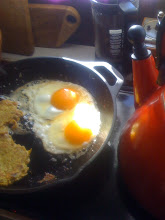
Each morning as I study or write, I listen for the sound of my breakfast sizzling in the kitchen. When Rick and I sit down to the breakfast he has made me, I wait for his assessment of the newest of my HG (hunter-gatherer) egg finds-- Were the shells hard? Are the yolks deeply colored? How do they taste? Did they run out of the shell or hold together (the latter a sign of freshness)?
Eggs are a staple at our house. We eat them for breakfast, we add them to soups, we bake with them--especially useful to make up for the baking properties of the gluten we don't eat. So, of course, the quality of these eggs is incredibly important. I always strive to find the best sources of each food that we eat, but deciding what is actually best is not so simple. For a while in the U.S. we accepted that "organic" meant "best" as far as food went. But recently we have been asking more questions: is it more responsible to choose locally produced food? What if that local food is pesticide laden? What if my local farmer grows food organically but chooses not to become certified? What does organic mean now, with watered-down standards in place? And animals can be fed organic feed and still be confined in barns and/or cages. Does free-range trump organic? Does free-range mean anything that we can actually pin down? Some of the labels we see have amounted to greenwashing, the use of a "green" term that has no teeth enforcing it--it sounds good, but means little.
So, as far as the eggs go, we are confronted with a confusing array of choices: free-roaming or cage free (they are not in cages but may be confined to a barn without any sunlight, despite claims of "access to the outdoors"--that's a small open door somewhere that the chickens don't know to use), organic (given feed without pesticide, no hormones or antibiotics), vegetarian (exclusively grain-fed), high omega 3 (fed a supplement, usually flax, to boost omega 3 fatty acids). Some of these eggs come in cartons decorated with folk motifs or have brand names that sound like they are from a small farm. But most of this hype is just that, worthless marketing. Because chickens are omnivores. Left to their own devices, they will happily roam around outdoors, scratching for bugs and worms, nibbling plants, eating seeds, absorbing sunlight. The eggs from truly pastured chickens have substantial shells, unlike the frail ones from the battery eggs in the supermarket--this reflects the higher mineral content of their diet. The yolks of the eggs are a deep yellow, sometimes orange, showing the fat soluble vitamins (such as A, D, E, K) that the chickens synthesize from their diverse diet and from the sun. (See this article for more on the nutrient content of pastured eggs.) And the eggs taste eggy, real.
Yo u may not really know what I mean by that until you have the chance to try a real egg. We have eaten many eggs over the last few years, but the best were from S's farm this summer. They were lovely to look at and absolutely delicious. The chickens have the run of the farm, and have new digs for laying, built by the apprentices this summer. They pay for their keep by keeping the bug population down--and of course, by giving the prized eggs. Here in Miami we have a few choices: good organic/high omega eggs from Delicious Organics which are in good supply; eggs raised locally using a "chicken tractor" from Bee Heaven Farm-- sold by shares ,which go fast; and our newest option, delivery of pastured eggs from farms from further north in Florida. Some of these eggs come close to S's eggs--orangey/yellow yolks, deep eggy flavor, shells that don't crumble when they are cracked.
Now that I have great eggs, I have to work on finding the best pastured pork belly, because I sure do miss the smell of our home-cured bacon in the mornings . . .
Eggs are a staple at our house. We eat them for breakfast, we add them to soups, we bake with them--especially useful to make up for the baking properties of the gluten we don't eat. So, of course, the quality of these eggs is incredibly important. I always strive to find the best sources of each food that we eat, but deciding what is actually best is not so simple. For a while in the U.S. we accepted that "organic" meant "best" as far as food went. But recently we have been asking more questions: is it more responsible to choose locally produced food? What if that local food is pesticide laden? What if my local farmer grows food organically but chooses not to become certified? What does organic mean now, with watered-down standards in place? And animals can be fed organic feed and still be confined in barns and/or cages. Does free-range trump organic? Does free-range mean anything that we can actually pin down? Some of the labels we see have amounted to greenwashing, the use of a "green" term that has no teeth enforcing it--it sounds good, but means little.
So, as far as the eggs go, we are confronted with a confusing array of choices: free-roaming or cage free (they are not in cages but may be confined to a barn without any sunlight, despite claims of "access to the outdoors"--that's a small open door somewhere that the chickens don't know to use), organic (given feed without pesticide, no hormones or antibiotics), vegetarian (exclusively grain-fed), high omega 3 (fed a supplement, usually flax, to boost omega 3 fatty acids). Some of these eggs come in cartons decorated with folk motifs or have brand names that sound like they are from a small farm. But most of this hype is just that, worthless marketing. Because chickens are omnivores. Left to their own devices, they will happily roam around outdoors, scratching for bugs and worms, nibbling plants, eating seeds, absorbing sunlight. The eggs from truly pastured chickens have substantial shells, unlike the frail ones from the battery eggs in the supermarket--this reflects the higher mineral content of their diet. The yolks of the eggs are a deep yellow, sometimes orange, showing the fat soluble vitamins (such as A, D, E, K) that the chickens synthesize from their diverse diet and from the sun. (See this article for more on the nutrient content of pastured eggs.) And the eggs taste eggy, real.
Yo
 u may not really know what I mean by that until you have the chance to try a real egg. We have eaten many eggs over the last few years, but the best were from S's farm this summer. They were lovely to look at and absolutely delicious. The chickens have the run of the farm, and have new digs for laying, built by the apprentices this summer. They pay for their keep by keeping the bug population down--and of course, by giving the prized eggs. Here in Miami we have a few choices: good organic/high omega eggs from Delicious Organics which are in good supply; eggs raised locally using a "chicken tractor" from Bee Heaven Farm-- sold by shares ,which go fast; and our newest option, delivery of pastured eggs from farms from further north in Florida. Some of these eggs come close to S's eggs--orangey/yellow yolks, deep eggy flavor, shells that don't crumble when they are cracked.
Now that I have great eggs, I have to work on finding the best pastured pork belly, because I sure do miss the smell of our home-cured bacon in the mornings . . .
Subscribe to:
Posts (Atom)


 Posts
Posts


